Goods Jam: Goods Sorting
- 4.6
- Rating
- 1.00M
- Installs
- Free
- Price
 Analysis by App-foxy
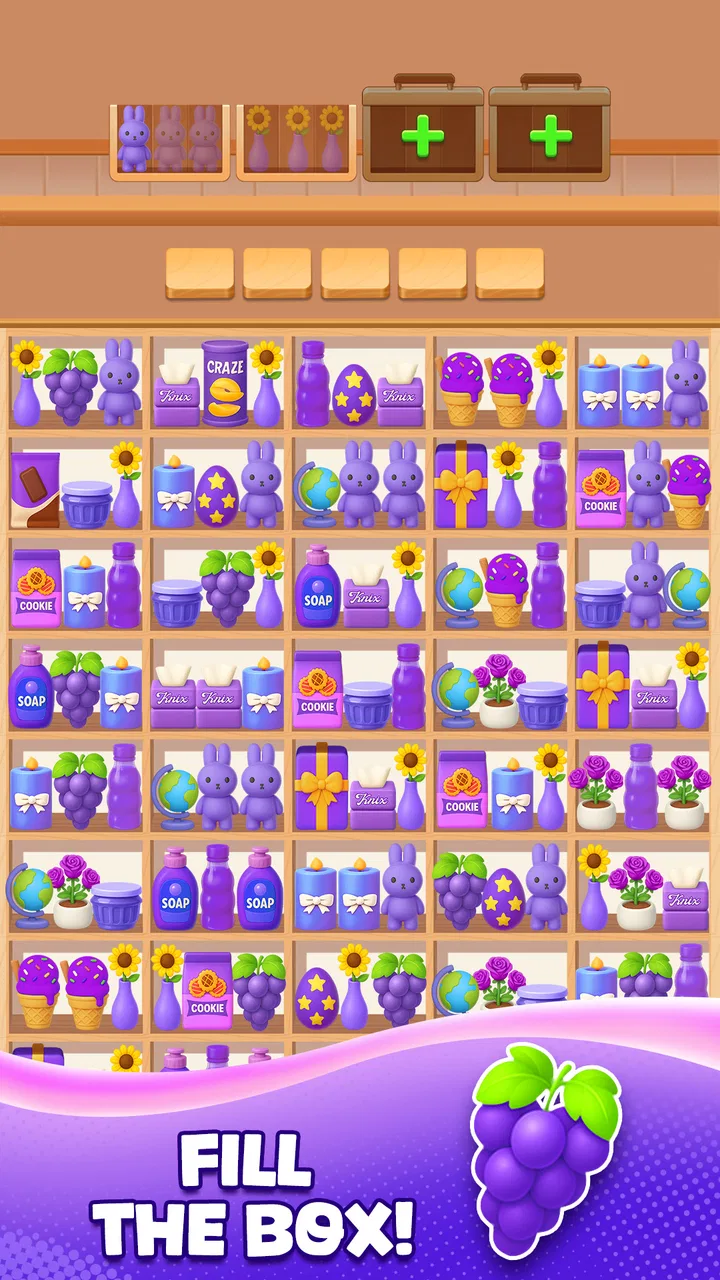
I spent time with Goods Jam: Goods Sorting, a free puzzle game from iKame Games - Zego Studio, and its main appeal became clear quickly: it turns arranging everyday-looking merchandise into a three-dimensional matching challenge. The goal is not simply to spot identical icons on a flat board. You have to sort, match three items, and manage the visible space around them before the pile becomes difficult to read. That extra layer gives the game a more hands-on feel than a standard match-three title.
At first glance, this looks like a gentle sorting game for short breaks. In practice, the 3D presentation makes each decision more important. Items can overlap visually, useful pieces may sit behind less useful ones, and a move that seems harmless can leave the remaining goods in an awkward arrangement. I found that the game works best when I stopped treating every available match as an automatic move and started thinking about what each match would reveal or clear next.
Why the 3D sorting idea matters
The verified store summary describes the core loop as sorting, matching three, and mastering goods jam in 3D goods sorting. That wording points to the feature that separates this game from a routine tile-matching board: the puzzle is shaped by depth and clutter. Instead of scanning a clean grid, I am looking at a compact display of goods and deciding which group can be completed without blocking a better opportunity.
You May Also Like

 Blood Strike: 2.5 Anniversary
Blood Strike’s Loadouts Turn Every Drop Into a Tactical Gamble
A close look at Blood Strike’s custom loadouts: how fast access to signature weapons reshapes its battle royale rhythm, rewards preparation, and narrows the gap between fights.

 Pandora - Music & Podcasts
Pandora’s Music Is Easy to Start, but Harder to Recover
Pandora’s strength is its low-effort path from a seed to a station. Its weak spot is how much confidence it asks you to place in connection, setup, and quiet recovery.

 8 Ball Pool
 Is Built on Rivalries, Rematches, and Routine
A close look at the rivalries, rematches, shared routines, and unanswered safety questions that turn a quick pool match into a persistent mobile community.

 Samsung Music
’s Quiet Strength Is Playing What You Already Own
Its reach comes less from spectacle than from dependable access to a personal library. That simplicity is both the app’s strongest retention engine and its ceiling.

 AccuWeather: Weather Radar
AccuWeather Review: A Quick, Clear Forecast for Everyday Decisions
For everyday plans, the best forecast is the one you can understand quickly. AccuWeather makes rain timing, radar, and local conditions easy to act on, with a few trade-offs.

 Hill Climb Racing
Why Hill Climb Racing Still Turns Crashes Into One More Run
A tiny car, a bumpy hill and one more upgrade: Hill Climb Racing keeps resurfacing because its simple chaos makes every near-miss feel personal.
More From Our News Desk
View All News


This changes the rhythm of play. In a conventional match-three game, the board often tells me where the next move is through a clear row, column, or obvious combination. Here, the challenge is more about controlling visibility and space. A match can be valuable because it removes a group, but it can also be valuable because it exposes something underneath. That makes the act of sorting feel closer to organizing a crowded shelf than simply tapping matching pictures.
The distinction is small but meaningful. I do not need complicated rules to understand what I am doing, yet I still have to make choices. That combination makes Goods Jam approachable for someone who wants a puzzle that can be learned immediately but does not become completely automatic after the first few moves.
It is also why the game is more suitable for players who enjoy visual organization than for people seeking a fast arcade reaction test. The satisfaction comes from finding order in a messy arrangement. If you like grouping objects by type, clearing a crowded desktop, or planning a sequence before touching anything, the central idea should feel natural.
Reading the board before making a match
My most useful adjustment was to pause before tapping the first obvious group. The visible match is not always the best opening. I look for three things: which items are easy to remove, which pieces are covering other goods, and whether completing a group will leave the remaining space easier or harder to read.
This approach makes the game less wasteful. When several matches are available, I usually prefer the one that opens the most useful area rather than the one that merely disappears fastest. That is a practical tip that does not appear in the short store description, but it makes a noticeable difference during crowded stages. The game rewards a player who treats each match as part of a sequence instead of as an isolated action.
A second useful habit is to keep a mental note of incomplete groups. If I see two matching goods and a possible third one partly hidden, I avoid filling the available space with unrelated items unless I have a clear reason. This helps prevent the board from becoming visually noisy. It is especially helpful when several product types are mixed together and the next helpful piece is not immediately exposed.
The result is a puzzle that asks for light planning without demanding a notebook or a long setup. I can make progress through observation alone, which keeps the experience comfortable on a phone. At the same time, rushing through every visible match removes much of the strategy and can make the board feel more confusing than it needs to be.
How the gameplay fits into an ordinary day
The free price makes it easy to try without committing money at the start, and the Everyone content rating makes the concept broadly accessible. I can imagine opening it while waiting for an appointment, taking a few turns during a commute, or using it as a quiet break between tasks. Its visual premise is simple enough that I do not need to remember a story or rebuild a complicated control scheme after putting the phone down.
A realistic use case is a short evening reset after work. I might have only a few minutes and want something more engaging than scrolling, but I may not have the attention for a long strategy session. Goods Jam gives me a focused task: inspect the pile, identify a sensible group, and decide whether clearing it improves the board. That small loop is satisfying because the progress is visible immediately.
There is a trade-off in that convenience. Players who prefer deep campaigns, character development, or a strong narrative reason to continue will not find that in the central sorting idea. This is a game about the puzzle in front of me, not about building a world around it. I consider that a strength for casual play, but a limitation for anyone who needs a larger sense of progression to stay interested.
The three-dimensional presentation also affects comfort. On a small screen, a busy arrangement can require more careful inspection than a flat color-matching board. I sometimes need to slow down and distinguish what is available from what is visually tucked behind another item. That is not a flaw in the concept; it is the cost of making depth part of the challenge. Still, players with limited patience for visual clutter may prefer a cleaner puzzle format.
Where it stands beside familiar puzzle alternatives
Compared with a traditional match-three game built around a tidy grid, this title places more emphasis on object recognition and spatial order. A grid-based alternative may be better when I want rapid combinations, obvious movement rules, and a board that can be understood in one glance. Goods Jam is more appealing when I want the act of arranging goods to be the puzzle itself.
It also differs from a pure sorting game because matching three gives the organization a clear payoff. I am not just placing objects into categories; I am trying to remove groups while preserving enough room and visibility to continue. That creates a useful middle ground between relaxing organization and cautious puzzle planning.
Against hidden-object games, the experience is less about searching for one specific answer and more about managing several possible answers at once. Against match-three games, it is less about chain reactions and more about making the next section of the board readable. Those comparisons help explain who will enjoy it: people who like visual clutter when it can be gradually turned into order.
The game has earned a 4.6 average from around 94 thousand ratings, with over 1 million installs, which matches my impression that the basic idea is easy for a wide audience to understand. Those figures do not guarantee that every player will enjoy the pacing, but they do reflect how accessible the premise is. The store record also lists around 920 written reviews, giving prospective players more than just a single overall score to consider.
Small decisions that improve a play session
One effective workflow is to divide the board mentally into immediate matches and future matches. Immediate matches are groups I can complete now. Future matches are pairs or partially hidden sets that may become useful after a clearing move. Keeping those two categories separate prevents me from accidentally using a piece that I was relying on to finish a more important group later.
I also try not to judge a move only by how much it removes. A smaller match can be the better choice if it uncovers a useful item or creates a clearer route through the remaining goods. This is one of the more interesting consequences of the 3D format: progress is not always measured by the largest visible disappearance. Sometimes the best move is the one that improves the board's structure.
When I feel stuck, I stop scanning the entire arrangement and focus on one exposed area. Looking everywhere at once makes similar goods blend together, especially when the display is busy. Narrowing attention to a single section helps me identify what can be safely cleared and what should remain untouched. It is a simple method, but it turns a vague sense of confusion into a manageable sequence.
Another practical tip is to treat open space as a resource. I do not fill every available position merely because a piece can be placed there. Leaving room for a likely group gives me more flexibility later. This matters because an apparently harmless placement can make the next few choices harder to see. The game is most enjoyable when I plan around space rather than reacting to every item independently.
The real trade-offs behind the relaxing presentation
Goods Jam presents itself as an easy-to-understand casual puzzle, but its visual simplicity should not be mistaken for complete effortlessness. The more goods appear together, the more important careful reading becomes. I enjoy that tension, yet I can also see why someone looking for instant, low-attention entertainment might find it slower than expected.
The main friction is the possibility of misreading the arrangement. In a flat board, a match is usually defined by position and color or symbol. In a 3D sorting layout, the player must also interpret what is accessible and what is visually behind something else. That creates a stronger sense of space, but it can make a session feel less smooth when I want to play quickly.
The free-to-start model is another practical consideration. The game costs nothing to download, while optional in-app purchases range from $0.99 to $99.99 per item. I would approach those purchases carefully and decide in advance whether I am comfortable spending anything. For me, the best way to evaluate the game is to begin with the free experience and see whether the sorting loop remains enjoyable without treating purchases as part of the basic appeal.
That price range also means the game is not equally suitable for every household's approach to mobile gaming. Someone who wants a completely fixed-cost puzzle may prefer a paid alternative with no optional item purchases. On the other hand, a player who values trying a game before paying may appreciate being able to start for free. The right choice depends less on the puzzle itself than on how comfortable the player is with optional spending.
The age rating of Everyone supports its broad, non-specialized presentation. I would still recommend that families make their own decisions about in-app purchases, especially if a shared device is used. The game is easy to understand, but financial settings deserve the same attention as the content rating.
Who gets the most from this particular puzzle
I would recommend it most to players who enjoy sorting, grouping, and gradual visual cleanup. It is a good fit for someone who wants a puzzle that can be picked up quickly but still rewards thinking about order. It also suits players who find ordinary match-three boards too predictable and would like the added question of what is exposed, what is blocked, and how much room remains.
It may be especially appealing to people who like calm, object-focused games. The goods theme gives the board a tangible quality, and the act of clearing groups can feel satisfying without requiring a complicated narrative. If your favorite part of a puzzle is watching a disorganized layout become manageable, the 3D structure gives that feeling more weight than a standard flat grid usually can.
I would be less likely to recommend it to someone who wants competitive timing, elaborate combos, or a story-driven adventure. It is also not my first choice when I want a puzzle I can solve almost entirely on reflex. The best experience comes from pausing, comparing options, and thinking one or two moves ahead. Players who dislike visual clutter or prefer perfectly predictable boards may find a conventional match-three game more comfortable.
Device compatibility is reasonably broad, with the listed minimum operating system being Android 7.0. The current version is 1.123.0, so anyone installing it should use a compatible Android device and keep the app updated through the normal store process. I would not choose a device solely for this game, but its stated system requirement makes it accessible to a range of older Android phones as well as newer models.
My recommendation after focusing on the core loop
What I like most is that the 3D format is not merely decoration. It changes how I make decisions. I am constantly weighing the benefit of an immediate match against the value of exposing another item or preserving open space. That gives the game a more thoughtful identity than its simple premise might suggest.
Its limitations are equally clear. The visual arrangement can become busy, the experience will not satisfy players looking for a deep story or competitive action, and optional purchases mean that the free entry point deserves a little financial awareness. Those are not reasons to dismiss it; they simply define the audience more precisely.
After playing it, I see Goods Jam: Goods Sorting as a strong choice for short, focused puzzle sessions built around 3D organization. I would tell a friend to try it if they enjoy matching games but want more control over the order in which the board opens up. I would suggest a cleaner grid-based alternative to someone who values speed and instant readability. For the right player, though, the central capability is genuinely worthwhile: turning a crowded collection of goods into a sequence of deliberate, satisfying matches.
FAQs for Goods Jam: Goods Sorting
01What is Goods Jam: Goods Sorting, and how do you play it?
Goods Jam: Goods Sorting is a casual organization puzzle game focused on arranging matching products into the correct places. During each level, you sort colorful goods, group identical items, and clear shelves or containers while dealing with limited space and increasing complexity. The controls are generally simple and tap-based, making the game easy to understand, although later stages require more planning and careful sequencing.
02Is Goods Jam: Goods Sorting free to download and play?
Goods Jam: Goods Sorting can generally be downloaded for free on supported Android and iOS devices. However, the free version may include advertising, optional purchases, or other limitations depending on the platform and current release. You can usually progress without spending money, but players who want extra hints, boosters, or a smoother experience may encounter in-app purchase offers during gameplay.
03Does Goods Jam: Goods Sorting work offline?
Many of the sorting puzzles in Goods Jam: Goods Sorting can be played without a constant internet connection, which makes the game suitable for short sessions while traveling or when mobile data is unavailable. Nevertheless, an internet connection may still be needed for advertisements, cloud features, updates, special events, or restoring purchases. Offline availability can also vary between versions and devices.
04Is Goods Jam: Goods Sorting suitable for children and casual players?
Goods Jam: Goods Sorting is designed to be approachable, with straightforward tap controls and visually recognizable products. It can suit casual players and older children who enjoy matching, sorting, and organization puzzles. Parents should still check the store’s age rating and review advertising or purchase settings, since the game may display promotional content or optional transactions even though the core gameplay is non-violent.
05Are there hints, boosters, or difficulty increases in Goods Jam: Goods Sorting?
The game typically introduces more challenging arrangements as you advance, including additional products, tighter spaces, and levels that demand better planning. When a puzzle becomes difficult, hints or boosters may be available to help reveal a move or recover from a mistake. These assistance features may be limited, earned through gameplay, or offered through optional purchases, so using them strategically is advisable.
Pros
- Simple drag-and-sort gameplay that is easy to understand.
- Short levels make it convenient for quick gaming sessions.
- Bright visuals and tidy layouts make items easy to identify.
- Gradual challenges help keep the experience engaging.
- Works well for players who enjoy relaxing organization puzzles.
Cons
- Later levels can feel repetitive if played for long periods.
- Limited move space may make some puzzles feel frustrating.
- Hints or extra moves may be restricted behind ads or purchases.
- Frequent ads can interrupt the flow between levels.
- Requires patience when several similar-looking goods appear together.

Goods Jam: Goods Sorting
Gallery